About
Pondering a life of digitizing nature
What I'm Up To
After 36 years directing University of California field stations—26 at the James San Jacinto Mountains Reserve and 10 at Blue Oak Ranch Reserve—I retired to Oregon City, Oregon and established Canemah Nature Laboratory. The lab sits above Willamette Falls, the largest waterfall in the Pacific Northwest by volume, and the ancestral fishing grounds of the Clackamas and neighboring peoples. Canemah is Chinook for "the canoe place."
The work continues what it always was: building tools to sense, record, and understand the living world. The difference now is that I answer only to curiosity. No grant cycles, no committee meetings, no annual reports. Just the question that has driven everything since my dissertation at Cornell in 1983: how do we faithfully represent ecological systems through technology?
The Macroscope
The Macroscope is my lifetime project—a framework for integrating environmental data across four domains: EARTH (geography, climate, environment), LIFE (biodiversity, taxonomy, ecology), HOME (human habitat and built environment), and SELF (personal health, work, reading, writing). It began as a concept paper in 1984, with the first videodisc developed over the next two years; my Ph.D. advisor, Jim Lassoie, and I presented and published the project in 1986. It has since evolved through wireless sensor networks, embedded systems, and now AI-assisted monitoring.
At Canemah and on the Owl Farm testbed, the Macroscope reads its own instruments (weather, acoustic and air-quality stations, 360-degree cameras and a drone) alongside community records and reference layers for about 1,170 curated places, from field stations to public lands. The data lives in a PostgreSQL/PostGIS database, and a narration layer, STRATA, uses Claude to say what the instruments show, and only what is measured.
Projects & Sites
What started as one website has grown into a small constellation of sites, all self-hosted on a Mac Mini in my office, powered by Portland General Electric's renewable energy program.
Canemah Nature Laboratory
The lab's home base. Live environmental data, project catalog, and the CNL technical document archive—field notes, specifications, and working papers that document the research as it unfolds.
The Macroscope
The lifetime project: an open ecological observatory in which a place reads its own ground, designed and built with Claude since 2025. The public Observatory is at macroscope.nexus; the fourth-generation Reader is being built in the open at macroscope.earth.
Science with Claude
Morning sessions in synthesis and reflection, and the structured investigations that grew from them. Essays written collaboratively with Claude, exploring the intersections of ecology, technology, philosophy, and lived experience. This is where the reading and thinking become writing.
Digital Naturalist
Journal of a 20th century eco-geek. Originally a weekly newspaper column in the Idyllwild Town Crier (1996–1997), now an evolving digital archive of natural history writing from the San Jacinto Mountains and beyond.
2Spiral
Semantic play in two minds. Experimental language games including Madverse (collaborative puzzle poetry) and the Wiki-Lyrical Engine (cognitive poetry from the dream buffer). The playful side of human-AI collaboration.
Hot Water
A science fiction novel. Because sometimes the best way to think about where technology is taking us is through story.
Animal Vegetable Robot
Independent publishing. The imprint for work that doesn't fit neatly into academic or commercial categories.
Writing
I've always written—scientific papers, grant proposals, field notes, a newspaper column, a novel. But the most interesting writing is happening now, in retirement, through a daily practice of reading and synthesis. Most mornings start early with coffee and a conversation with Claude, working through whatever I've been reading—ecology, philosophy, technology, history—and seeing what emerges. The essays on Science with Claude are the public record of that practice.
The CNL Archive documents the technical side: field notes from sensor deployments, specifications for new systems, and working papers that track the evolution of ideas in real time. It's less polished than the essays, and that's the point.
Retirement
Retirement is a misnomer. The institutional obligations ended; the work didn't. What changed is the freedom to follow curiosity without justifying it to a funding agency. I build what interests me, write what I'm thinking, and spend more time outside than at a desk.
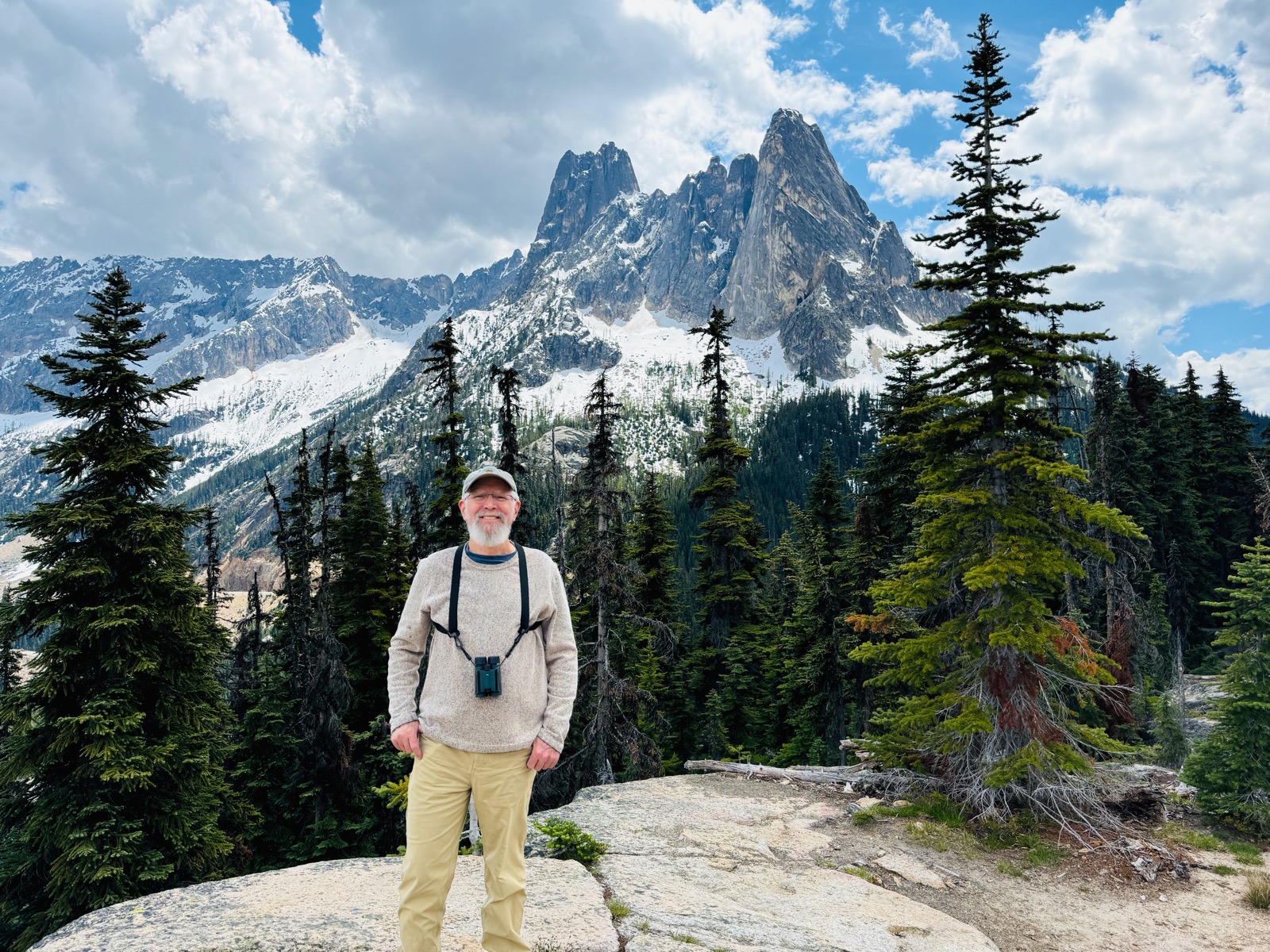
I'm a devoted birder—the BirdWeather network at Canemah is both research infrastructure and personal indulgence. I read widely. I maintain a quotes collection that has become its own form of intellectual autobiography. Merry and I split our time between Oregon City and Bellingham. The hot tub at sunrise remains non-negotiable.
Background
Ph.D. Natural Resources, Cornell University, 1983. B.S. and M.S. Biology, Cal Poly Pomona. My dissertation was on rare plant management in the San Jacinto Mountains wilderness—fieldwork that led directly to 26 years directing the James Reserve. I was a co-PI on the NSF Center for Embedded Networked Sensing ($40M), which pioneered the use of wireless sensor networks in ecological research. That work shaped everything that followed.