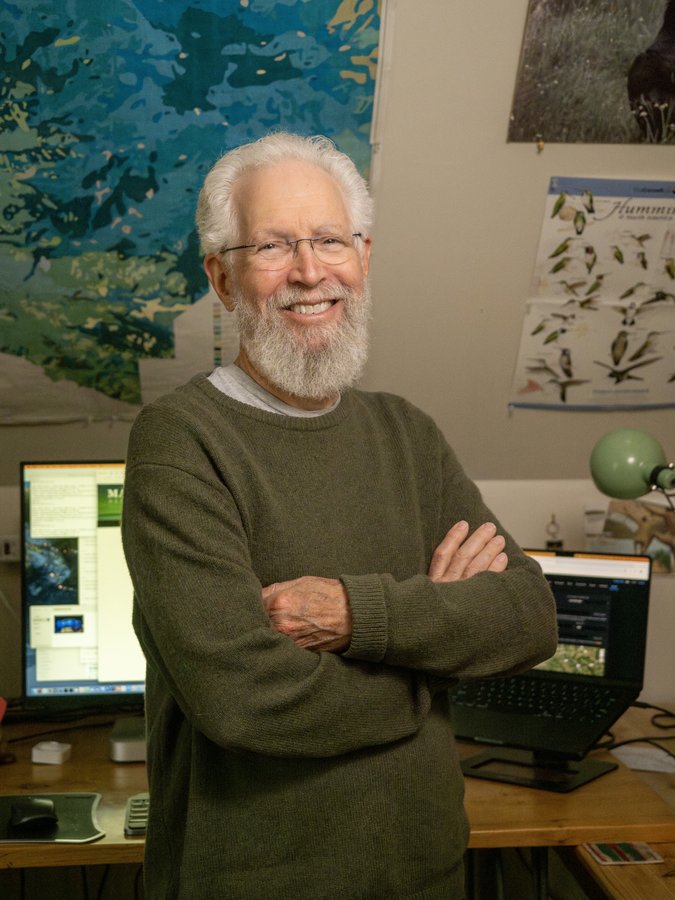
Michael P. Hamilton, Ph.D.
Ecological Researcher · Field Station Director (Retired) · Digital Naturalist
Director, Canemah Nature Laboratory · Oregon City, Oregon
- Location
- Oregon City, Oregon
- Contact form
- Laboratory
- Canemah Nature Laboratory
- Profiles
- Google Scholar · ResearchGate · LinkedIn · iNaturalist
Biography
Michael Hamilton came to ecology through broad field biology at Cal Poly Pomona (B.S. 1976, M.S. 1979), where his master's thesis on electronic monitoring of pollination ecology foreshadowed a career of instrumenting the living world. At Cornell, working with James Lassoie, he completed a doctorate in Natural Resources (1983) focused on science-based wilderness management and rare plant ecology in the San Jacinto Mountains—fieldwork that led directly to his appointment as director of the James San Jacinto Mountains Reserve.
Over twenty-six years at the James Reserve, Hamilton built one of the most technologically advanced ecological field stations in the University of California system. As co-PI of the NSF Center for Embedded Networked Sensing (CENS), he pioneered the deployment of wireless sensor networks in ecological research—habitat monitoring, automated minirhizotrons, networked cameras for phenological observation, and underwater robotics. A decade directing Blue Oak Ranch Reserve for UC Berkeley followed, extending sensor network approaches to oak woodland ecosystems and drone-based thermal profiling of lakes. Since 2018, he has directed Canemah Nature Laboratory in Oregon City, above Willamette Falls—an independent laboratory for the design, engineering and development of the Macroscope, a lifetime project to make ecosystems legible through technology, built with Claude as engineering collaborator since 2025. He is a collaborator in the NSF-funded Virtual Field Research Coordination Network.
Research Interests
Hamilton's research spans ecological sensing systems, computational ecology, and biodiversity informatics, unified by the question of how to faithfully represent ecological systems through technology. Early work in floristics and rare plant conservation gave way to embedded sensor networks and real-time environmental monitoring. Current interests center on AI-assisted ecological interpretation, immersive environmental visualization, and the integration of heterogeneous data streams—weather, soil, acoustic, visual—into coherent ecological narratives. A persistent theme is field station science: the design, management, and technological evolution of places where long-term ecological observation happens.
Current Projects
- The Macroscope
- The fourth-generation Macroscope, designed and built with Claude since 2025: an open ecological observatory in which a place reads its own ground, across about 1,170 curated places. The public Observatory is at macroscope.nexus and yea.earth (Your Ecological Address); the Reader is being built in the open at macroscope.earth.
- Canemah Nature Laboratory
- Independent laboratory above Willamette Falls, Oregon City, for the design, engineering and development of the Macroscope: instruments, a technical report archive, and home base.
- Science with Claude
- Structured human-AI scientific investigations, and essays in synthesis—science, technology, philosophy, and lived experience—in which the ideas behind the Macroscope are worked out in public.
- Virtual Field
- Collaborator in the NSF-funded Virtual Field Research Coordination Network. The Macroscope holds 455 of its field-station panoramas, from 33 stations.
- Hot Water
- A science fiction trilogy exploring the consequences of environmental and technological change.
- 2Spiral
- Semantic play in two minds—collaborative language games and experimental tools including Madverse (puzzle poetry), the Wiki-Lyrical Engine, NodeWorlds, a curated quotes database, and a semantic explorer.
Select Publications
- 2007. New Approaches in Embedded Networked Sensing for Terrestrial Ecological Observatories. Environmental Engineering Science 24(2): 192–204.
- 2010. Perspectives on Next Generation Technology for Environmental Sensor Networks. Frontiers in Ecology and the Environment 8(4): 193–200.
- 2007. Soil Sensor Technology: Life Within a Pixel. BioScience 57(10): 859–869.
- 2004. Habitat Monitoring with Sensor Networks. Communications of the ACM 47(6): 34–40.
- 2013. EcoIP: An Open Source Image Analysis Toolkit to Identify Different Stages of Plant Phenology for Multiple Species with Pan-Tilt-Zoom Cameras. Ecological Informatics 15: 58–65.
- 2009. Budburst and Leaf Area Expansion Measured with a Novel Mobile Camera System and Simple Color Thresholding. Environmental and Experimental Botany 65: 238–244.
- 2015. Obtaining the Thermal Structure of Lakes from the Air. Water 7: 6467–6482.
- 2007. Experiments with Underwater Robot Localization and Tracking. Proceedings of the IEEE International Conference on Robotics and Automation, Rome: 4556–4561.
- 2001. Habitat Monitoring: Application Driver for Wireless Communications Technology. Proceedings of the First ACM SIGCOMM Workshop on Data Communications in Latin America and the Caribbean, San Jose, Costa Rica.
- 1989. Geographic Information Systems: Providing Information for Wildland Fire Planning. Fire Technology 25(1): 5–23.
- 1986. Rare Plant Management in Wilderness: Theory, Design and Implementation. USDA Forest Service Gen. Tech. Rep. INT-212: 100–107.
Select Presentations
- 2023. The Urban Forest Digital Twin: Technologies to Build Virtual Forests for Urban Forestry, STEM Education, and Public Outreach. Ecological Society of America, Annual Meeting, Portland, Oregon.
- 2019. Animal, Vegetable, Robot: How Eco-technologies Have Transformed Field Research and Conservation Science at Ecological Reserves. Invited seminar, Department of Natural Resources, Cornell University.
- 2015. All Watched Over by Machines of Loving Grace. Keynote address, 17th Annual Meeting of the Society for Conservation GIS, Asilomar, California.
- 2004. CENS: New Directions in Wireless Embedded Networked Sensing of Natural and Agricultural Ecosystems. Keynote, Future Science Forum, Melbourne, Australia.
Education
- Ph.D., Natural Resources
- Cornell University, 1983
- M.S., Biology
- California State Polytechnic University, Pomona, 1979
- B.S., Biology
- California State Polytechnic University, Pomona, 1976 · cum laude
Select Honors & Affiliations
- CSIRO Sir Frederick McMaster Fellowship 2006
- Co-PI, NSF Center for Embedded Networked Sensing (CENS) 2002–2012
- Society for Conservation GIS (co-founder) 1997
- Sigma Xi Scientific Research Society (elected) 1983
- Organization of Biological Field Stations
- Natural Areas Association (life member)
Select Service
- Co-Chairman, Sensors & Sensor Networking, NEON National Design Consortium 2004–2007
- Research Executive Committee, UCLA Center for Embedded Networked Sensing 2001–2008
- Founding Chairman, UC Natural Reserve System Information Management Committee 2000–2009
- Rare Plant Scientific Advisory Committee, California Native Plant Society 1989–1999
- Ecology Professionals Technical Advisory Committee, Clackamas Community College 2018–2024
- Science Council, Playa Center for the Intersection of Art and Science 2021–2023